
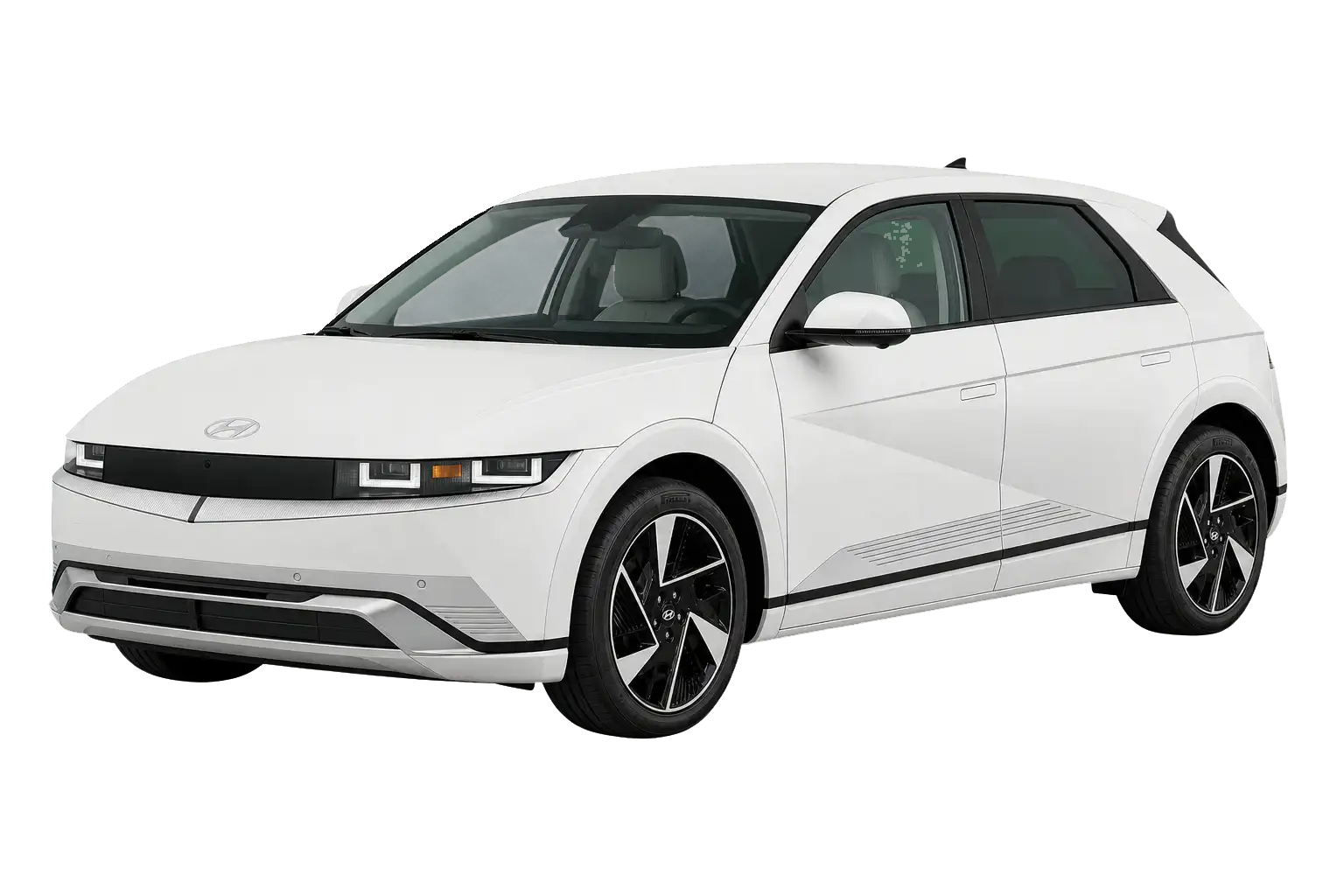
2025 Hyundai IONIQ 5 Standard Range
- Sport utility vehicle: Small
Public-source details are shown where available. Source context appears below.
Quick facts
- Electric range
- 373 km
- Combined electric efficiency
- 18.5 kWh/100 km
Specifications
Vehicle
- Body style
- Sport utility vehicle: Small
Powertrain
- Powertrain type
- Battery electric
- Transmission
- 1-speed automatic
- Fuel type
- Electricity
Range and efficiency
- Electric range
- 373 km
- City electric efficiency
- 16.6 kWh/100 km
- Highway electric efficiency
- 20.7 kWh/100 km
- Combined electric efficiency
- 18.5 kWh/100 km
Estimated driving energy cost
Electric driving cost
- Electricity cost per kilometre
- about $0.02/km
- Energy use
- 18.5 kWh/100 km combined
Assumptions
- Electricity-rate assumption
- $0.12/kWh
- Annual distance assumption
- 15,000 km/year
- Province assumption
- British Columbia
- Source
- Manual electricity assumption
How calculated
18.5 kWh/100 km x $0.12/kWh / 100 = $0.02/km
Formula: kWh/100 km x electricity price per kWh / 100 = cost per km.
This estimates driving energy only, not total ownership cost. Actual fuel or electricity cost varies with prices, weather, driving, energy-source mix, and vehicle condition.
Vehicle charging
- NRCan-listed recharge time
- 5.8 hours
NRCan defines this as the estimated time to fully recharge the battery at 240 volts. The imported NRCan value does not specify charging power, connector, or a detailed starting and ending battery percentage. This is not a DC fast-charging estimate.
Daily driving and fast-charging reach
The rated electric range equals approximately 21.9 typical provincial commute days. This is a statistical comparison, not a prediction of how often an individual driver should charge.
Location is requested only after you choose Use my current location. Exact coordinates stay in this browser session and are never sent to Electric Driver.
Choose a starting point to see the maximum return-trip outbound distance and full one-way vehicle reach.
Compatible charger filtering is unavailable because the vehicle’s native DC connector has not been established.
Loading the local map. The accessible charger summary remains available below.
The geographic basemap is unavailable. The accessible charger list remains available below.
Map distances
Range planning notice: The displayed reach starts with the vehicle’s listed rated range and is an estimate, not a guarantee. Real-world range can be reduced by driving speed and style, traffic, route and elevation, cold or hot weather, wind, rain or snow, cabin heating and air conditioning, passenger or cargo load, towing, tire type and pressure, battery age and condition, and starting charge. The circles show straight-line distance rather than driving distance; roads, detours, charger availability and a safe arrival reserve can further reduce how far you should plan to travel. Confirm your route, conditions, remaining charge and charging options before departure. Charging-station availability is not real-time.
Adapted from Statistics Canada, Commuting duration by main mode of commuting and time leaving for work: Canada, provinces and territories, census divisions and census subdivisions, 2021 Census of Population, November 30, 2022. This does not constitute an endorsement by Statistics Canada of this product. Basemap: Protomaps © OpenStreetMap contributors. Place search and province boundaries: Government of Canada open data.
Independent public records
Safety and crash protection
Review verified U.S. crash-test context and model-level Canadian recall information separately. Each source has different coverage and limitations.
U.S. crash-test rating
Safety rating unavailable
A verified NHTSA rating has not been matched to this exact model year and configuration.
NHTSA publishes crash-test ratings for U.S.-market vehicles. Electric Driver shows stars only after the corresponding Canadian vehicle has been reviewed and verified.
Canada
Model-level recall information
3 Canadian recalls matched for this model
Results are based on year, make and model matching and are not VIN-specific. Check this vehicle’s VIN with Transport Canada or the manufacturer.
Recall 2025193 April 10, 2025 · Brakes Issue: On certain vehicles, the software update completed by a Hyundai dealer for recall R0277 (Transport Canada recall no. 2025-054) may not be effective. As a result, a second repair is required. On certain vehicles, a software problem in the integrated electronic brake could cause reduced braking when using t...
- Manufacturer recall number
- R0279 (51D100)
- Recall date
- April 10, 2025
- System or component
- Brakes
- Affected units reported
- 440
What Transport Canada reports
Issue: On certain vehicles, the software update completed by a Hyundai dealer for recall R0277 (Transport Canada recall no. 2025-054) may not be effective. As a result, a second repair is required. On certain vehicles, a software problem in the integrated electronic brake could cause reduced braking when using the left-foot braking (LFB) feature. Additionally, a software problem in the vehicle control unit could cause the vehicle to continue to accelerate for a short period of time when using the N e-Shift feature. Note: This recall replaces recall R0277 (Transport Canada recall no. 2025-054). This recall only affects certain Ioniq 5 N models. Safety Risk: Reduced braking can cause extended stopping distances and increase the risk of a crash. A vehicle that continues to accelerate could create the risk of a crash. Corrective Actions: To reduce the safety risk, Hyundai recommends not to use the LFB or N e-SHIFT features until the recall repairs have been completed. Hyundai will notify owners by mail and advise you to take your vehicle to a dealership to update the integrated electronic brake and vehicle control unit software.
Recall 2025054 February 6, 2025 · Brakes This recall was replaced by Transport Canada recall no. 2025-193. Issue: On certain vehicles, a software problem in the integrated electronic brake could cause reduced braking when using the left-foot braking (LFB) feature. Note: This recall only affects certain Ioniq 5 N models. Safety Risk: Reduced bra...
- Manufacturer recall number
- R0277
- Recall date
- February 6, 2025
- System or component
- Brakes
- Affected units reported
- 429
What Transport Canada reports
This recall was replaced by Transport Canada recall no. 2025-193. Issue: On certain vehicles, a software problem in the integrated electronic brake could cause reduced braking when using the left-foot braking (LFB) feature. Note: This recall only affects certain Ioniq 5 N models. Safety Risk: Reduced braking can cause extended stopping distances and increase the risk of a crash. Corrective Actions: To reduce the safety risk, Hyundai recommends not to use the LFB feature until the recall repairs have been completed. Hyundai will notify owners by mail and send a wireless over-the-air software update to eligible vehicles to update the integrated electronic brake and vehicle control unit software. Alternatively, you may schedule an appointment to have the update performed at a Hyundai dealership. Note: Potential complications have been reported with the corrective actions and, as a result, the recall campaign is currently suspended. Hyundai is investigating the root cause and will provide an update once available. For owners who have already had the recall repairs completed, it is advised NOT TO USE the N e-SHIFT feature.
Recall 2024552 September 23, 2024 · Label Issue: On certain vehicles, the compliance label may be missing information in French. The words listed on the label for "Tires", "Rims", "Front" and "Rear" appear in English only, when they should be listed as "Tires/Pneus", "Rims/Jantes", "Front/Avant" and "Rear/Arriere". Canadian regulations require this informat...
- Manufacturer recall number
- R0260
- Recall date
- September 23, 2024
- System or component
- Label
- Affected units reported
- 824,695
What Transport Canada reports
Issue: On certain vehicles, the compliance label may be missing information in French. The words listed on the label for "Tires", "Rims", "Front" and "Rear" appear in English only, when they should be listed as "Tires/Pneus", "Rims/Jantes", "Front/Avant" and "Rear/Arriere". Canadian regulations require this information to be listed on the label in both English and French. Safety Risk: These small errors do not affect vehicle safety. Corrective Actions: This is not a recall. The company has corrected the compliance label for all new vehicles.
Local recall source refreshed: July 9, 2026
Physical vehicle inlet
Connector data unavailable
Electric Driver has not yet independently verified the physical charging inlet for this exact model year and configuration.
Ratings and recall records are provided for research and comparison. A rating does not guarantee protection in every crash, and a model-level recall match does not confirm whether a specific VIN is affected.
Sources and data confidence
- Vehicle efficiency source
- NRCan vehicle efficiency data
- Data status
- Some specifications have not yet been verified.
- Powertrain source confidence
- High source confidence
- Driving-cost source
- Manual electricity assumption
- Safety and recall sources
- NHTSA 5-Star Safety Ratings, Transport Canada Vehicle Recalls Database
- Last updated
- July 8, 2026
Electric Driver uses locally cached public data and reviewed editorial sources where available. Raw rows are retained for auditing but are not shown publicly; confirm configuration-specific details with the cited official sources.