
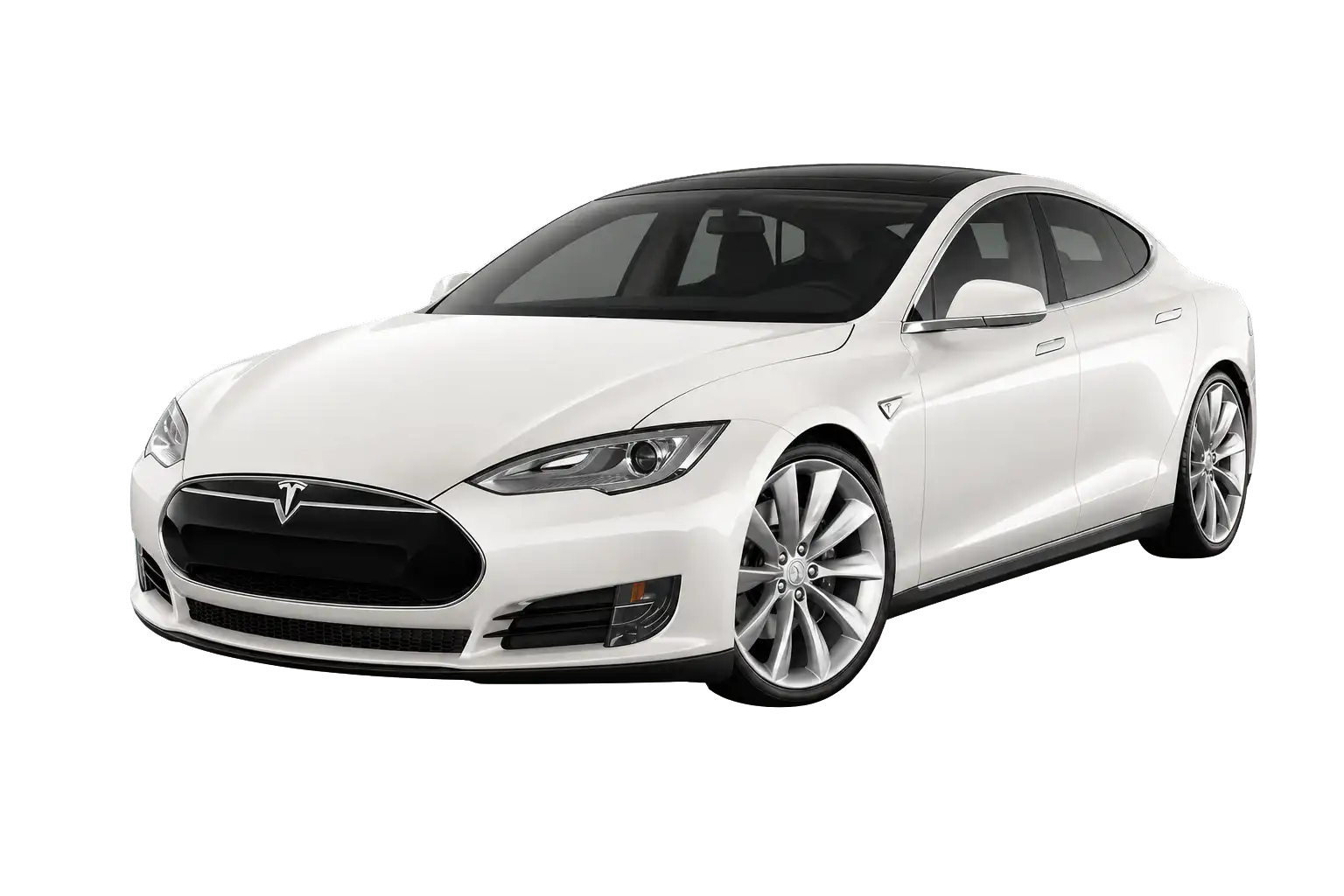
2014 Tesla Model S (60 kWh)
- Full-size
Public-source details are shown where available. Source context appears below.
Quick facts
- Electric range
- 335 km
- Combined electric efficiency
- 21.9 kWh/100 km
Specifications
Vehicle
- Body style
- Full-size
Powertrain
- Powertrain type
- Battery electric
- Transmission
- 1-speed automatic
- Fuel type
- Electricity
Range and efficiency
- Electric range
- 335 km
- City electric efficiency
- 22.2 kWh/100 km
- Highway electric efficiency
- 21.7 kWh/100 km
- Combined electric efficiency
- 21.9 kWh/100 km
Estimated driving energy cost
Electric driving cost
- Electricity cost per kilometre
- about $0.03/km
- Energy use
- 21.9 kWh/100 km combined
Assumptions
- Electricity-rate assumption
- $0.12/kWh
- Annual distance assumption
- 15,000 km/year
- Province assumption
- British Columbia
- Source
- Manual electricity assumption
How calculated
21.9 kWh/100 km x $0.12/kWh / 100 = $0.03/km
Formula: kWh/100 km x electricity price per kWh / 100 = cost per km.
This estimates driving energy only, not total ownership cost. Actual fuel or electricity cost varies with prices, weather, driving, energy-source mix, and vehicle condition.
Vehicle charging
- NRCan-listed recharge time
- 10 hours
NRCan defines this as the estimated time to fully recharge the battery at 240 volts. The imported NRCan value does not specify charging power, connector, or a detailed starting and ending battery percentage. This is not a DC fast-charging estimate.
Daily driving and fast-charging reach
The rated electric range equals approximately 19.7 typical provincial commute days. This is a statistical comparison, not a prediction of how often an individual driver should charge.
Location is requested only after you choose Use my current location. Exact coordinates stay in this browser session and are never sent to Electric Driver.
Choose a starting point to see the maximum return-trip outbound distance and full one-way vehicle reach.
Compatible charger filtering is unavailable because the vehicle’s native DC connector has not been established.
Loading the local map. The accessible charger summary remains available below.
The geographic basemap is unavailable. The accessible charger list remains available below.
Map distances
Range planning notice: The displayed reach starts with the vehicle’s listed rated range and is an estimate, not a guarantee. Real-world range can be reduced by driving speed and style, traffic, route and elevation, cold or hot weather, wind, rain or snow, cabin heating and air conditioning, passenger or cargo load, towing, tire type and pressure, battery age and condition, and starting charge. The circles show straight-line distance rather than driving distance; roads, detours, charger availability and a safe arrival reserve can further reduce how far you should plan to travel. Confirm your route, conditions, remaining charge and charging options before departure. Charging-station availability is not real-time.
Adapted from Statistics Canada, Commuting duration by main mode of commuting and time leaving for work: Canada, provinces and territories, census divisions and census subdivisions, 2021 Census of Population, November 30, 2022. This does not constitute an endorsement by Statistics Canada of this product. Basemap: Protomaps © OpenStreetMap contributors. Place search and province boundaries: Government of Canada open data.
Independent public records
Safety and crash protection
Review verified U.S. crash-test context and model-level Canadian recall information separately. Each source has different coverage and limitations.
U.S. crash-test rating
Safety rating unavailable
A verified NHTSA rating has not been matched to this exact model year and configuration.
NHTSA publishes crash-test ratings for U.S.-market vehicles. Electric Driver shows stars only after the corresponding Canadian vehicle has been reviewed and verified.
Canada
Model-level recall information
10 Canadian recalls matched for this model
Results are based on year, make and model matching and are not VIN-specific. Check this vehicle’s VIN with Transport Canada or the manufacturer.
Recall 2019004 January 7, 2019 · Airbag Issue: On certain vehicles, long-term exposure to high absolute humidity and temperature, combined with high temperature cycling, may eventually degrade the propellant contained in the passenger-front airbag. This could cause the airbag to deploy with more force than normal. If the airbag inflator ruptures, fragments...
- Manufacturer recall number
- SB-19-20-001
- Recall date
- January 7, 2019
- System or component
- Airbag
- Affected units reported
- 4,583
What Transport Canada reports
Issue: On certain vehicles, long-term exposure to high absolute humidity and temperature, combined with high temperature cycling, may eventually degrade the propellant contained in the passenger-front airbag. This could cause the airbag to deploy with more force than normal. If the airbag inflator ruptures, fragments could be propelled toward vehicle occupants or cause damage to the airbag assembly, preventing its proper function. Safety Risk: If the vehicle is involved in a crash requiring an airbag deployment, the airbag inflator could rupture and create a risk of injury. Corrective Actions: Owners will be notified by mail and instructed to take their vehicle to a Tesla service center to have the passenger-front airbag inflator replaced. Note: The Canadian climate results in the propellant degrading slowly. This recall is being conducted as a precaution to address future risk. It is expected that all airbag inflators will be replaced before their function would be affected.
Recall 2018149 March 29, 2018 · Steering On certain vehicles, the bolts that attach the power steering gear assist motor to the gear housing may corrode and fracture. This could allow the power steering gear assist motor to move, causing the belt to slip which could result in a loss of power steering assist. A loss of power steering assist would require add...
- Manufacturer recall number
- SB-18-32-002
- Recall date
- March 29, 2018
- System or component
- Steering
- Affected units reported
- 4,275
What Transport Canada reports
On certain vehicles, the bolts that attach the power steering gear assist motor to the gear housing may corrode and fracture. This could allow the power steering gear assist motor to move, causing the belt to slip which could result in a loss of power steering assist. A loss of power steering assist would require additional steering effort which could increase the risk of a crash causing injury and/or damage to property. Correction: Tesla service centers will replace the aluminum mounting bolts with coated steel bolts and will apply a corrosion-preventative sealer around the gear housing and connecting bolts. If bolts are found to be broken or break during the removal process, Tesla will also install a new steering gear.
Recall 2016614 December 8, 2016 · Electrical *** This notice is provided for information purposes only as the subject equipment is not regulated under the Motor Vehicle Safety Act *** The NEMA 14-30, NEMA 10-30 and NEMA 6-50 electrical adapter that could have been separately purchased as an accessory for the universal mobile charging connector on certain Tesl...
- Recall date
- December 8, 2016
- System or component
- Electrical
- Affected units reported
- 280
What Transport Canada reports
*** This notice is provided for information purposes only as the subject equipment is not regulated under the Motor Vehicle Safety Act *** The NEMA 14-30, NEMA 10-30 and NEMA 6-50 electrical adapter that could have been separately purchased as an accessory for the universal mobile charging connector on certain Tesla Motors vehicles may be impacted by higher than normal electrical resistance due to a potential manufacturing defect. This could cause the adapter to overheat, potentially increasing the risk of a fire causing injury and/or damage to property. Correction: impacted owners will be supplied with a redesigned NEMA adapter. Updated adapters will be sent by Canada Post or commercial carrier once available.
Recall 2015553 November 19, 2015 · Seats And Restraints On certain vehicles, the driver and front passenger seatbelt anchor plate may not have been properly bolted to the pretensioner anchor plate during assembly. In the event of a crash, the seatbelt may be unable to provide sufficient restraint force, which could increase the risk of injury to the seat occupant. Correcti...
- Recall date
- November 19, 2015
- System or component
- Seats And Restraints
- Affected units reported
- 3,911
What Transport Canada reports
On certain vehicles, the driver and front passenger seatbelt anchor plate may not have been properly bolted to the pretensioner anchor plate during assembly. In the event of a crash, the seatbelt may be unable to provide sufficient restraint force, which could increase the risk of injury to the seat occupant. Correction: Tesla Service Technicians at authorized locations will inspect and affect repairs as necessary.
Recall 2014009 January 21, 2014 · Electrical *** This notice is provided for information purposes only as the subject equipment is not regulated under the Motor Vehicle Safety Act *** The NEMA 14-50 electrical adapter, supplied with the universal mobile charging connector on certain Tesla Motors vehicles, may be impacted by higher than normal electrical resis...
- Manufacturer recall number
- 1
- Recall date
- January 21, 2014
- System or component
- Electrical
- Affected units reported
- 750
What Transport Canada reports
*** This notice is provided for information purposes only as the subject equipment is not regulated under the Motor Vehicle Safety Act *** The NEMA 14-50 electrical adapter, supplied with the universal mobile charging connector on certain Tesla Motors vehicles, may be impacted by higher than normal electrical resistance due to variations in external sources of electricity. This could cause the plug and/or wall receptacle to deform, melt, or overheat, potentially resulting in an electrical short and increasing the risk of a fire. Correction: Vehicle software has been updated over the air already to reduce charging current if a high-resistance condition is detected. As an extra measure of assurance, owners will be supplied with a redesigned NEMA 14-50 adapter containing an internal thermal fuse. Updated adapters will be sent by Canada Post or commercial carrier once available.
Local recall source refreshed: July 9, 2026
Physical vehicle inlet
Connector data unavailable
Electric Driver has not yet independently verified the physical charging inlet for this exact model year and configuration.
Ratings and recall records are provided for research and comparison. A rating does not guarantee protection in every crash, and a model-level recall match does not confirm whether a specific VIN is affected.
Sources and data confidence
- Vehicle efficiency source
- NRCan vehicle efficiency data
- Data status
- Some specifications have not yet been verified.
- Powertrain source confidence
- High source confidence
- Driving-cost source
- Manual electricity assumption
- Safety and recall sources
- NHTSA 5-Star Safety Ratings, Transport Canada Vehicle Recalls Database
- Last updated
- July 8, 2026
Electric Driver uses locally cached public data and reviewed editorial sources where available. Raw rows are retained for auditing but are not shown publicly; confirm configuration-specific details with the cited official sources.